
Blueprint plugin
AI multi-agent system that turns an idea into a store-ready app in 3 days
Context
We were shipping mobile apps at high speed at 14x and noticed 80% of the work was identical mechanical setup: same Firebase flow, same App Store Connect compliance surveys, same Sentry config, same 41 locales. The decisions were different each time, but the execution was the same.
Blueprint & Implement is a Claude Code plugin system we built that orchestrates the entire lifecycle of creating a mobile or web application, from initial product interview through keyword research, design system creation, codebase scaffolding, and parallel multi-agent implementation.
The problem
Launching a new app involves dozens of disconnected tasks across different platforms: creating Firebase projects, registering apps in App Store Connect, setting up analytics, writing privacy policies, generating store metadata in 40 languages, configuring subscriptions, running security audits.
Each task requires context from previous decisions: pricing affects the paywall, keywords affect naming, which affects store listings, which affects blog content. Most of this is mechanical, repeatable, and error-prone. The real value is in the product decisions, everything else is execution.
The solution
A two-phase system:
Phase 1: Blueprint
A 7-step pipeline that turns a raw idea into a complete implementation plan:
/ideate > /keyword-research > /interview > /design > /plan > /generate > /generate-website
Each step builds on the previous: the product interview locks pricing decisions, keyword research (4 data sources: Google/Apple Autocomplete, Apple Search Ads, Google Trends) shapes app naming and website copy, technical interviews capture architecture decisions, and the plan synthesizes everything into phase-gated agent sub-plans.
Output: a scaffolded, compilable codebase (iOS Swift, Android Kotlin, or Next.js 16 with 41 locales) with all research embedded in .blueprint/ for full traceability.
Phase 2: Implement
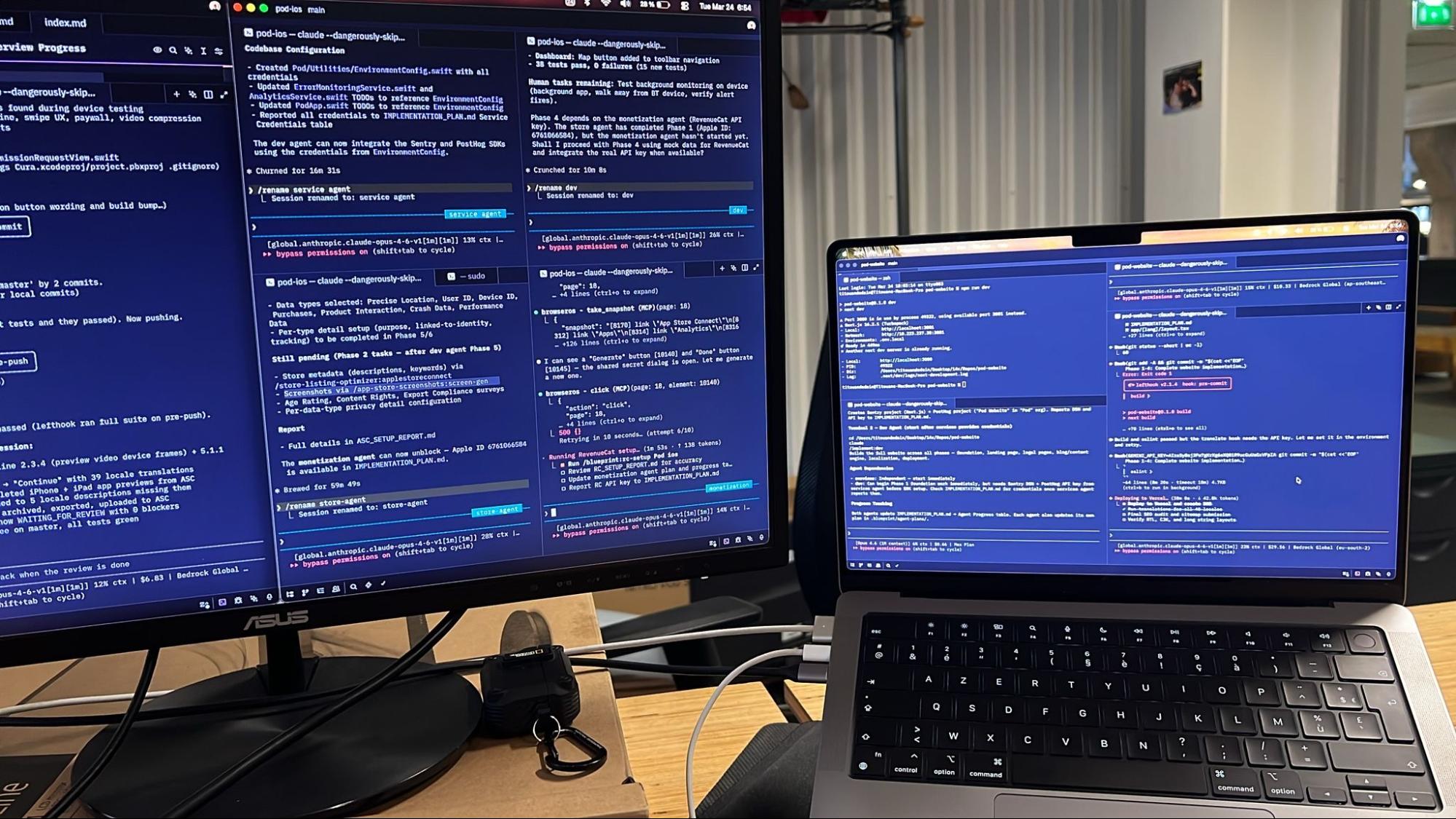
4 AI agents run in parallel terminals, each following its own plan:
- services - Provisions Firebase, Sentry, PostHog via browser automation (BrowserOS)
- store - Creates App Store Connect / Google Play record, locales, compliance
- dev - Builds features phase-by-phase with verification gates
- monetization - Sets up RevenueCat subscriptions + paywall UI (blocked until store finishes)
Technical highlights
Browser automation as infrastructure. Firebase, Sentry, PostHog, and App Store Connect are all provisioned through browser automation. The AI drives the actual web UIs, handling auth flows, form filling, and multi-step wizards. This was necessary because not everything is feasible through CLI or APIs.
Keyword-driven decisions. Research from 4 data sources feeds into app naming, website headlines, store metadata, FAQ generation, and blog content strategy. Nothing is arbitrary, every copy decision traces back to data. The model is constrained to provide backed data only, and the impact was noticeable on our keyword ranking.
Agent coordination without shared state. Agents coordinate through a flat markdown file. No databases, no message queues, just file reads and writes on a shared repository. Simple, debuggable, and version-controlled.
Embedded provenance. Every generated codebase contains all research artifacts: the product interview, keyword strategy, technical decisions, and design tokens. Any agent (or human) can trace why a decision was made months later.
Outcomes
This system is what powered the rapid shipping of Signature Maker, Cura, Pod, and SnapQuiz. It replaced weeks of manual setup per app with a structured pipeline where the human focuses on product thinking and the system handles execution.
Retrospective
The biggest unlock was treating browser automation as infrastructure. Many developer services don't have APIs for everything (App Store Connect compliance surveys, Firebase project creation, Sentry setup). Instead of waiting for APIs that may never come, driving the actual UIs through automation solved the problem completely.
The flat-file coordination between agents was surprisingly effective. No need for complex orchestration frameworks. Agents just read and write to shared markdown files in the repo. Simple, debuggable, version-controlled.
Learnings
Automate the mechanical, keep the decisions human. The pipeline is explicitly designed so that AI handles execution (scaffolding, provisioning, configuration) while humans handle product thinking (ideation, keyword strategy, design preferences). Phase gates prevent AI from running ahead without validation.
Convention embedding beats documentation. Each scaffolded codebase includes comprehensive developer references so any AI agent working in the repo later has full context. This means the system's output is self-documenting and future-proof.