
Impulsion
AI-powered voice sales training platform for construction companies
Context
Impulsion was born directly from the ashes of ProcessFlow. After months of discovery calls with ops leaders and SOP documenters, we'd hit a wall: the problem ProcessFlow tried to solve wasn't a software problem, it was a human one. No one was ready to pay for it.
During one of these calls, we connected with a mid-sized commercial contractor in the Bay Area. They were interested, but wanted someone on-site. I flew to San Francisco. What we found there wasn't a documentation problem. It was a training problem, particularly on the sales team.
The problem
New sales reps in construction take 6 to 12 months to become productive. Each unproductive month costs tens of thousands to the company, with zero revenue contribution. A bad hire costs ~$75K+ to replace.
The root cause was simple: no one on the management team had enough time to shadow new reps and train them properly. The ramp was slow, unstructured, and expensive. Traditional approaches (ride-alongs, shadowing top performers, reading playbooks) couldn't scale.
We saw an opportunity: use conversational AI to simulate realistic customer interactions, letting reps practice as much as needed before going on the field.
The solution
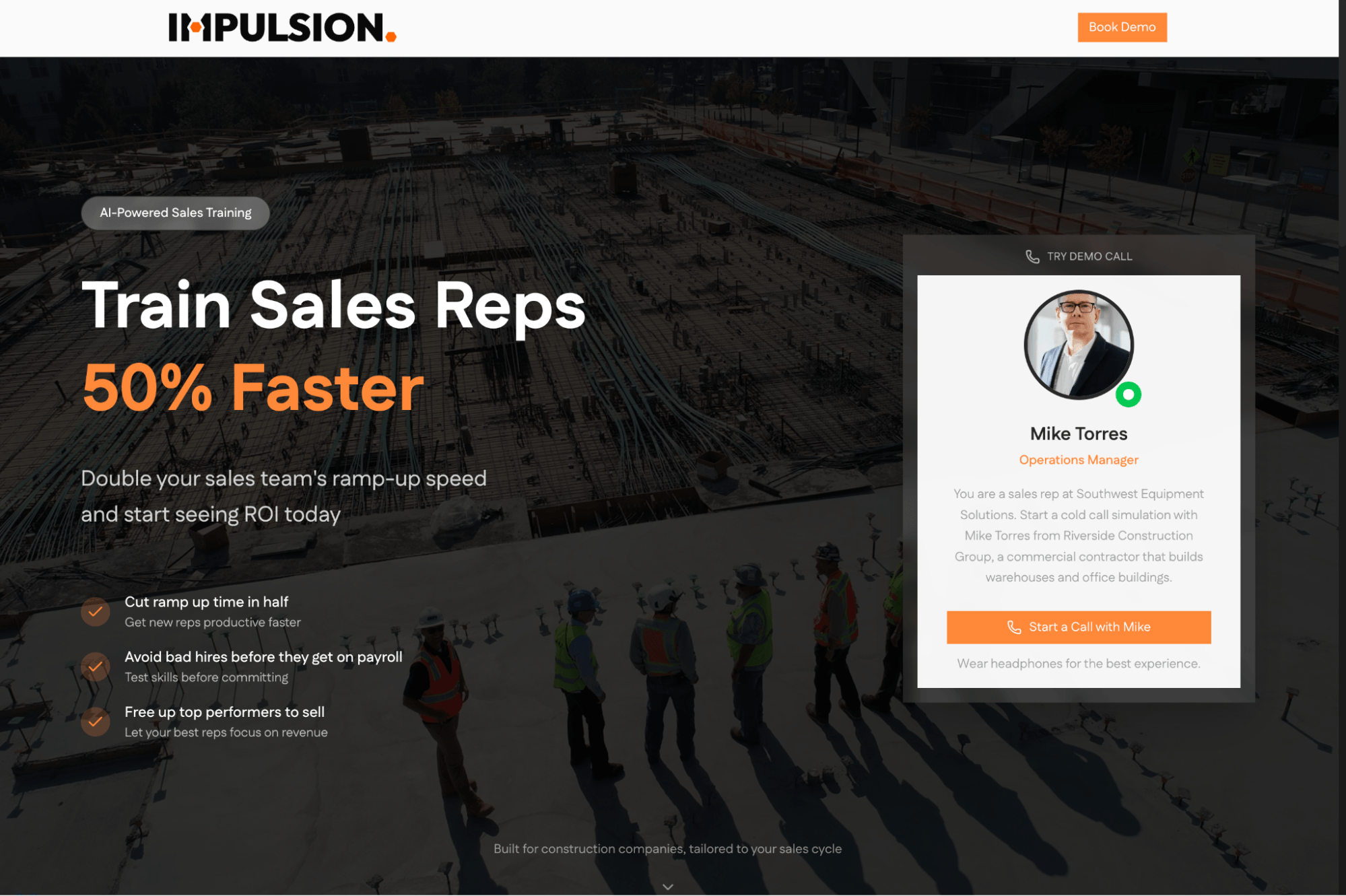
We built an AI-powered sales training platform specifically for construction companies. The core experience: a rep picks a difficulty level, enters a voice conversation with an AI-generated customer persona, and practices selling. After the call, they receive the full transcript, a performance breakdown, and actionable feedback on what to improve.
RAG-Powered Personas
We built a retrieval-augmented generation pipeline using OpenAI embeddings, fed with character backgrounds and behavioral instructions. The AI personas weren't generic: they had names, backgrounds, and realistic construction industry context (operations managers, project leads, skeptical buyers).
Voice Infrastructure
The technical challenge was making the AI sound human. Not just in voice quality, but in behavior. The persona needed to get impatient if the rep rambled, push back on weak pitches, and respond with realistic timing.
We initially dug deep into a custom Livekit solution with Cerebras for faster inference, optimizing time-to-first-token to achieve near-human response latency. We explored Kyutai for open-source voice and Hume AI to inject emotional variation: frustration, skepticism, enthusiasm. Ultimately, ElevenLabs offered the best quality out of the box, with everything bundled: voice synthesis, conversation management, and low latency.
Manager Dashboard
Sales managers could monitor their team's progress: who was practicing, how they were improving, where they were stuck. The goal was to free top performers from training duties and give managers visibility without requiring their direct time.
Outcomes
We never signed the deal.
The product worked. The AI sounded convincing enough for experienced construction salespeople to take it seriously. The tech was solid. But discussions with our potential client moved slowly. Too slowly for a two-person team burning runway at Station F.
In parallel, we tried to validate a broader SaaS play by reaching out to other construction sales teams. But without a signed first client to point to, the conversation never gained traction. When the deal finally fell through, we killed the project. We didn't find a viable path to make it live for other companies without that anchor customer.
Retrospective
What worked:
- The voice experience was genuinely good. Realistic enough to create engagement and discomfort, which is exactly what training should do.
- The RAG approach meant we could spin up company-specific personas quickly from existing documentation.
- The product-engineering workflow between two people was efficient. We were never technically blocked.
What didn't work:
- We went all-in on a single opportunity. When that deal collapsed, we had nothing else lined up.
- The time between calls and decisions in B2B enterprise sales was brutal for a young startup with no network and no revenue cushion.
- We discovered, honestly, that we didn't enjoy the B2B sales motion. Chasing procurement cycles and multi-stakeholder approvals wasn't where we wanted to spend our energy and where we were the most efficient.
Learnings
Voice AI is an infrastructure problem, not a model problem. The hardest part wasn't choosing the right LLM. It was optimizing the full pipeline: time-to-first-token, audio streaming latency, emotional modulation, turn-taking behavior. I learned to operate Livekit at a low level, benchmark TTFT across providers, and integrate experimental models like Hume AI and Kyutai for emotion-aware synthesis. But finally, a tool with everything in the box was the better tradeoff. We learned how to select the correct solution based on a customer's needs.
First-time founders without a network pay a tax in B2B. Every opportunity took longer to materialize than it should have. The one real opportunity we had could have been the start of something, but as first-time founders with no warm intros, no proof points, and no sales engine, we were always one failed deal away from zero.
Know what you're willing to sell. We could build the product. We could validate the problem. But we couldn't (or didn't really want to) run the B2B sales cycle that this kind of product demanded. That realization was the most valuable outcome of Impulsion. It pushed us toward Lume, a B2C product where the distribution model matched our strengths better.